
Belief, Evidence, and the Cave
Point BlankRuth’s treasure hunt and the murder investigation show how observation and interpretation can rescue people from false conclusions, even when perception itself is under attack.
increasing Bearing strength in each event
 decreasing
Bearing strength in each eventdecreasingThe Map as Promise

The Map as Promise
Trust built from research
Ruth checks the paper, ink, and measurements before pursuing the map. Her optimism is grounded in investigation, not blind faith alone.
The lure of certainty
The map appears to promise a direct route to gold. Ruth’s excitement makes its instructions feel more reliable than the changing cave around her.
A lesson in limits
The experience shows that preparation cannot control every variable. Belief keeps Ruth searching, but it cannot substitute for a companion or a safe plan.
The World Without Reference

The World Without Reference
Instruments fail in meaning
Ruth’s compass and measuring tape still exist, but she can no longer interpret their readings reliably. A familiar tool becomes frightening when perception is distorted.
Fear fills the void
Darkness and hallucination supply explanations when her senses cannot locate a wall. Ruth experiences a reality that feels absolute even as it is false.
Experience without trust
Her ordeal warns that confidence in one’s own perception can be manipulated. BZ turns a trained investigator’s mind into an unreliable witness.
The Scene’s False Meaning

The Scene’s False Meaning
Ritual suggested
Erin’s posed body and partial embalming seem to announce a ritual killer. Investigators take seriously what the scene appears to tell them.
Staging revealed
The men who killed Erin used strange treatment to complicate the investigation. A visual pattern that feels meaningful can be a deliberate lie.
Interpretation revised
The agents revise their theory when financial and telephone records connect Helen to Dempsey and Slater. Evidence matters, but only after investigators ask who created it and why.
The Map Read Again
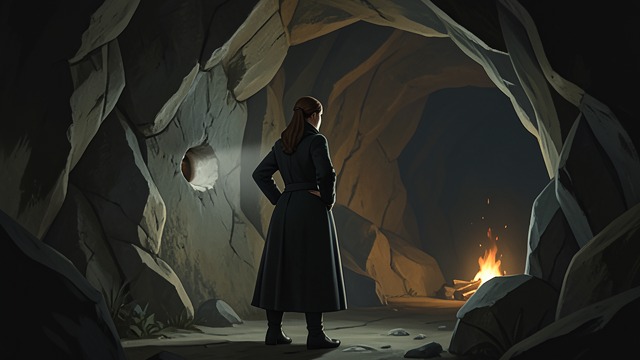
The Map Read Again
A literal clue
Ruth revisits the phrase directing her beneath the niche. Instead of treating the obvious chamber as the destination, she asks whether the wording points to a hidden level.
Physical confirmation
A hollow sound leads to boards concealed under earth. The discovery proves that the map’s incomplete appearance reflected deliberate concealment rather than a false promise.
Reasoned optimism
The gold is found through patient observation and a willingness to revise an assumption. Belief is most useful when it remains open to correction.
Memory as a Form of Evidence

Memory as a Form of Evidence
Personal recollection
Marilyn remembers a grandfather who used the name Malcolm and had a troubling relationship with Tammy. Details long held at the edge of consciousness become important evidence.
Corroboration matters
Savich connects those memories to Moses’s history and his obsession with Tammy. The identification is stronger because personal testimony joins other investigative facts.
Limits acknowledged
Memory can be incomplete or frightening, as Ruth’s amnesia demonstrates. The investigators succeed by treating recollection as meaningful evidence that still needs interpretation.
Before Ruth enters Winkel’s Cave
Friday afternoon, during Ruth’s exposure to BZ
Monday and Tuesday, as Erin’s body is examined
Monday afternoon, during Ruth and Dixon’s treasure search
Near the ending, when Marilyn identifies Malcolm
